
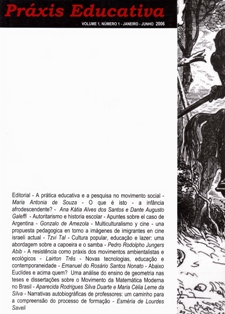
O que é isto - a infância afrodescendente?
Abstract
This paper aims to register reflections deepened within our Ph.D. in Education at the Universidade Federal da Bahia (Brazil). Through a comprehensive reading of the cultural roots of Afrodescendant childhood in the Bahian diaspora, we first analyze childhood’s conceptions, from the natural to the historical, accentuating in the latter, the Brazilian and Bahian Context in which this cultural group in socially and politically inserted. Our approach of the theme, explore the purpose of taking the Afrodescendant child as a subject of rights, as stated in the Child and Teenager Statute. This Statute valorizes culture and identity while both have been excluded and negated through the Brazilian historical course. With this Statute, cultures and identity became guaranteed rights in the social practice at large, inclusive in school. Finally, we try to contribute to the educators’ practices linked to the new guidelines (law 10.639, January 2003) for the teaching of History and Afro Brazilian and African cultures, which are now timidly implemented in all Brazilian primary schools.
Keywords: Afrodescendant Childhood. Culture. Identity. Brazil. Bahia. Children’s rights.
Downloads
Downloads
Published
Issue
Section
License
Authors who publish in this journal agree with the following terms:
a) Authors keep the copyrights and concede the right of its first publication to the magazine. The work piece must be simultaneously licensed on the Creative Commons Attribution License which allows the paper sharing, and preserves both the author identity and the right of first publication to this magazine.
b) Authors are authorized to assume additional contracts separately, to not-exclusively distribution of the paper version published in this magazine (e.g.: publish in institutional repository or as a book chapter), with the author identity recognition and its first publication in this magazine.
c) Authors are permitted and stimulated to publish and distribute their papers online (e.g.: in institutional repository or on their personal webpage), considering it can generate productive alterations, as well as increase the impact and the quotations of the published paper.
d) This journal provides public access to all its content, as this allows a greater visibility and reach of published articles and reviews. For more information on this approach, visit the Public Knowledge Project, a project that developed this system to improve the academic and public quality of the research, distributing OJS as well as other software to support the publication system of public access to academic sources.
e) The names and e-mail addresses on this site will be used exclusively for the purposes of the journal and are not available for other purposes.

This work is licensed under a Creative Commons Attribution 4.0 International License.


