
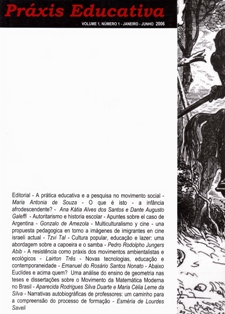
A prática educativa e a pesquisa no movimento social
Abstract
This paper aims to discuss some aspects of the educational practice and of the research on social movements, particularly on the Landless Rural Workers Movement. The intention is to set relations between the experiences lived in daily life of the social movement and of the permanent settlement and the traits of schooling life; to demonstrate the possibilities and the challenges of the links between the social movement educational theory and practice and that necessary to the curricular content comprehension; and to think about the educational research traits in the social movement. Gohn´s (1992) and Arroyo’ s (2004 a, b) ideas contributed to the thoughts on social movement educational dimensions and to the analyses of the rural social movement as an educational one. The social movement educational practice occurs in different fronts, such as in meetings, in the work cooperative space, in the confrontation either with the State or the land owners. The educators’ practice involves political capacitation and formation. In the pedagogical documents produced by the MST, it is implicit the role research plays in the educational practice. The educational proposals are born from the semminars’, meetings’ and events’ records; and it has as starting point in the educational practice at school, in life and in the productive activities in the permanent settlements. The educators’ and learners’ experiences question the shooling pedagogy and announce that the knowledge recognition constructed by the pedagogical process subjects is essential to the comprehension process and to the approppriation of the knowledge constructed along the human trajectory.
Keywords: Social movement. Educational practice. Research. Social trajectories.
Downloads
Downloads
Published
Issue
Section
License
Authors who publish in this journal agree with the following terms:
a) Authors keep the copyrights and concede the right of its first publication to the magazine. The work piece must be simultaneously licensed on the Creative Commons Attribution License which allows the paper sharing, and preserves both the author identity and the right of first publication to this magazine.
b) Authors are authorized to assume additional contracts separately, to not-exclusively distribution of the paper version published in this magazine (e.g.: publish in institutional repository or as a book chapter), with the author identity recognition and its first publication in this magazine.
c) Authors are permitted and stimulated to publish and distribute their papers online (e.g.: in institutional repository or on their personal webpage), considering it can generate productive alterations, as well as increase the impact and the quotations of the published paper.
d) This journal provides public access to all its content, as this allows a greater visibility and reach of published articles and reviews. For more information on this approach, visit the Public Knowledge Project, a project that developed this system to improve the academic and public quality of the research, distributing OJS as well as other software to support the publication system of public access to academic sources.
e) The names and e-mail addresses on this site will be used exclusively for the purposes of the journal and are not available for other purposes.

This work is licensed under a Creative Commons Attribution 4.0 International License.


