The topicality of Paulo Freire’s thinking to reinvent practices of political education within the scope of popular education
DOI:
https://doi.org/10.5212/PraxEduc.v.16.16623.058Abstract
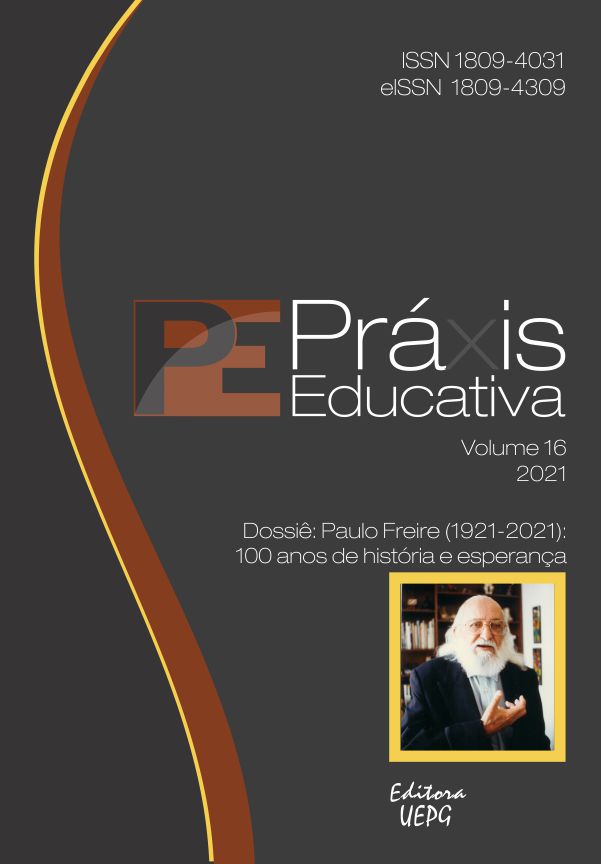
This article aims to discuss Popular Education within the scope of the Council of Popular Education of Latin America and the Caribbean (CEAAL), considering one of its basic assumptions the political education. The objective is to show how Paulo Freire’s presence, CEAAL’s first president, was fundamental to the formation and performance of this group throughout its history. The arguments are based on the identification of Freirean categories consolidated in the literature and present in the two most recent CEAAL documents in 2018 and 2019. Both documents are the product of the collective of popular educators from 21 countries in Latin America. A simplified lexical analysis was carried out with the Vayant Tools software, based on the word count in each text and compared to the entries in a dictionary on Freire’s work. The six categories identified contribute to a critical review and challenges of political education today from the perspective of popular education.
Keywords: Paulo Freire. Popular education. Political education.
Downloads
Published
Issue
Section
License
Authors who publish in this journal agree with the following terms:
a) Authors keep the copyrights and concede the right of its first publication to the magazine. The work piece must be simultaneously licensed on the Creative Commons Attribution License which allows the paper sharing, and preserves both the author identity and the right of first publication to this magazine.
b) Authors are authorized to assume additional contracts separately, to not-exclusively distribution of the paper version published in this magazine (e.g.: publish in institutional repository or as a book chapter), with the author identity recognition and its first publication in this magazine.
c) Authors are permitted and stimulated to publish and distribute their papers online (e.g.: in institutional repository or on their personal webpage), considering it can generate productive alterations, as well as increase the impact and the quotations of the published paper.
d) This journal provides public access to all its content, as this allows a greater visibility and reach of published articles and reviews. For more information on this approach, visit the Public Knowledge Project, a project that developed this system to improve the academic and public quality of the research, distributing OJS as well as other software to support the publication system of public access to academic sources.
e) The names and e-mail addresses on this site will be used exclusively for the purposes of the journal and are not available for other purposes.

This work is licensed under a Creative Commons Attribution 4.0 International License.